
The BOM Says NC. Why Did the Factory Still Place It?
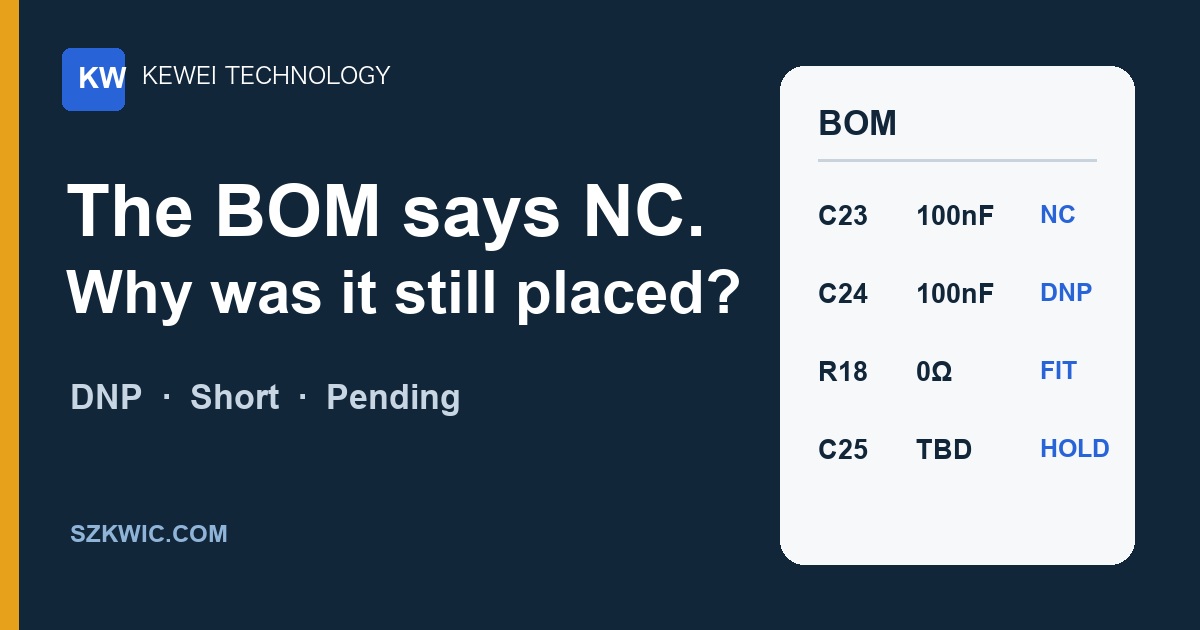
A BOM contains this line: C23, 100nF, 0603, NC.
Full article
A BOM contains this line: C23, 100nF, 0603, NC.
Purchasing asks whether to buy it. The warehouse looks at the quantity. Production receives a placement file and feeder list. One person treats NC as do-not-populate, another assumes the value is still undecided, and someone else decides a 0Ω resistor will do.
Two letters, four different actions
That is where the problem starts. NC is not an instruction that every department automatically interprets the same way. Depending on the company, it may mean not fitted, not connected, pending, or simply an engineering note left in the BOM. If the BOM, placement file, picking list and work instruction do not agree, the final board can differ from the design.
0Ω creates a short; it is not an unpopulated part
A 0Ω resistor connects the two pads and still has a current rating, package and soldering requirement. NC is normally an open circuit. On a power rail, ground return or signal path, those are completely different electrical states.
If the default configuration requires a short, write 0Ω or state the short condition explicitly. Do not use a 0Ω resistor because it happens to be in stock and call it an NC substitute.
The BOM and the placement file describe different things
Removing a designator from the BOM does not remove it from the placement file. If the machine still sees the position, it may place the part. On the purchasing side, an NC line without a clear status may be ordered as ordinary material and leave unused stock.
A revision should update the material status, placement file, picking list, work instruction and revision number together. Prototype-to-production transfers are especially prone to error because older files can remain in circulation.
Keeping the footprint is fine; leaving the status vague is not
EMC, RF matching, power margin and timing work often need reserved footprints. The pads should remain so that a capacitor can be added or a resistor value changed during tuning.
The important part is the status: is the position unpopulated in production, fitted during prototype tuning, or still waiting for a value and blocked from volume purchasing? Those are three different actions, and one NC should not stand for all of them.
Write the instruction production can actually follow
A practical BOM line looks more like this:
C23 100nF 0603: DNP in production, retain the footprint, fit only under the prototype tuning list.
R18 0Ω 0603: fitted in production as the default configuration short.
C25 0603: value pending, do not purchase for volume production, update the BOM and placement file after confirmation.
The wording does not need to be polished. Purchasing needs to understand it, production needs to execute it, and the next revision needs a traceable basis. The next time an NC appears, ask whether the part is fitted in production and whether the footprint stays. Many rework loops start because nobody asked.
What to ask before releasing the BOM
When a BOM says NC, state three things explicitly: whether the part is fitted in production, whether the footprint stays, and whether the prototype follows a tuning list. One less assumption prevents one more rework loop.
Authentic parts · Same-day shipping · Prototype and volume quantities